

+86-159 9860 6917
info@geofantex.com
geofantex@gmail.com
+86-400-8266163-44899
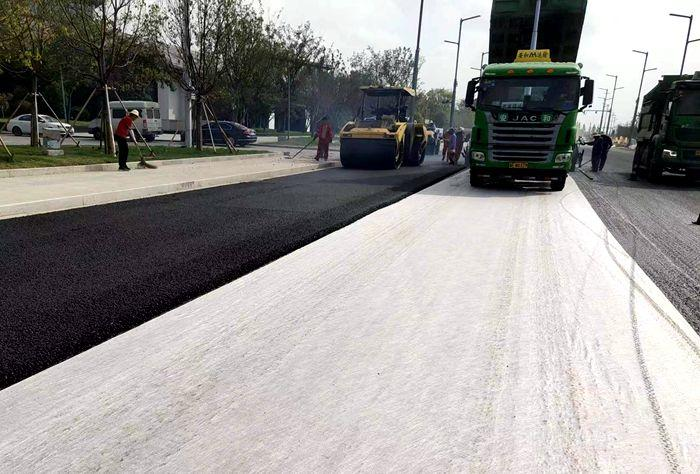
How to calculate geotextile fabric quantity is an important question for contractors, engineers, and project buyers preparing material estimates. An accurate calculation should include the actual coverage area, roll dimensions, overlaps, anchor trenches, irregular sections, and installation waste. Proper planning helps reduce shortages, unnecessary material costs, and delays in road, drainage, erosion control, and soil stabilization projects.
How to Calculate Geotextile Fabric Quantity by Area
Start by measuring the area that will be covered. For a rectangular site, use:
Required Area = Length × Width
For example, a 50 m × 20 m area requires a basic coverage of:
50 × 20 = 1,000 m²
This figure represents only the net area. It does not include overlaps, anchoring, trimming, or waste.
For slopes, measure the actual surface length rather than the horizontal projection. Embankments and steep slopes can require significantly more material than measurements taken from a plan view suggest.
Understanding how to calculate geotextile fabric quantity from actual site dimensions provides a more reliable starting point for procurement.
How to Calculate Geotextile for Irregular Areas
Construction sites often contain curves, drainage channels, corners, and irregular boundaries. Divide these areas into simple geometric shapes such as rectangles, triangles, and trapezoids.
Calculate each section separately, then add the results:
Total Coverage = Area 1 + Area 2 + Area 3 + …
This method is generally more accurate than estimating the entire site as one large rectangle.
Also include fabric required for anchor trenches, terminations, folds, and other installation details shown in the project drawings.
How to Calculate Geotextile Fabric Quantity Based on Roll Size
Roll dimensions directly affect the number of rolls required. Once the total coverage is known, calculate the area of one roll:
Roll Area = Roll Width × Roll Length
Then estimate:
Number of Rolls = Adjusted Project Area ÷ Roll Area
Always round up to the next complete roll when partial rolls cannot be ordered.
When determining how to calculate geotextile fabric quantity based on roll size, consider the installation layout as well. Wider rolls can reduce seams on large open areas, while narrower rolls may reduce cutting waste on confined or irregular sites.
Roll orientation should be planned before ordering to optimize coverage and handling efficiency.
How Should Overlaps Be Included?
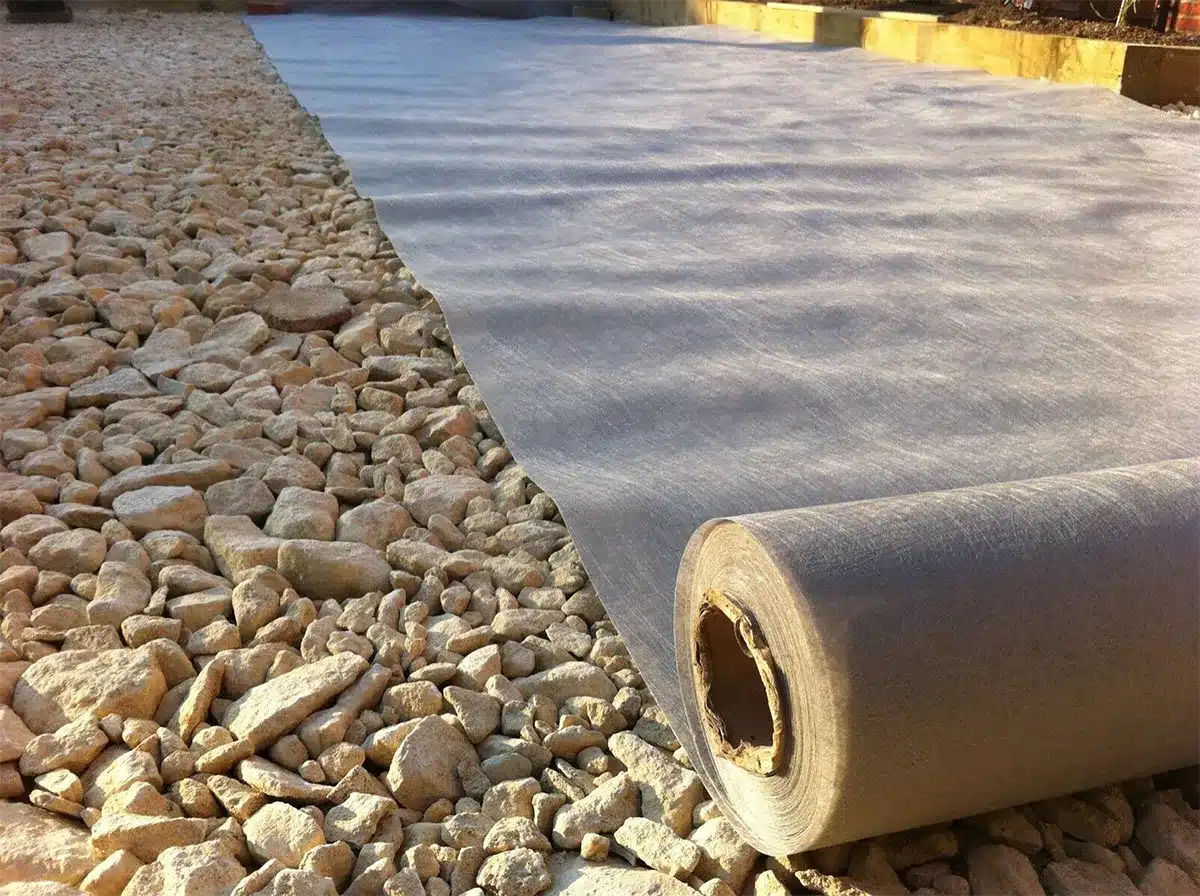
Adjacent geotextile panels normally require overlaps or specified connections to maintain continuous coverage. The required overlap depends on the application, subgrade conditions, construction method, and project specification.
Instead of assuming one universal overlap, calculate the additional width consumed at every seam.
For example, multiple parallel rolls across a wide road section may require several longitudinal overlaps. Although each overlap appears small, their combined area can significantly increase the total quantity on a large project.
This is why how to calculate geotextile fabric quantity should include a layout calculation rather than simply adding a percentage to the net site area.
How Much Extra Geotextile Should You Order?
After calculating net coverage and overlaps, include additional material for:
- Cutting and trimming
- Anchor trenches
- Curves and corners
- Irregular boundaries
- Installation adjustments
- Potential site damage
A project-specific allowance should be used instead of assuming that the same waste percentage applies everywhere. A simple rectangular installation may generate little waste, while complex slopes and drainage structures may require considerably more.
For preliminary purchasing estimates, a reasonable contingency can be added and then refined using the final installation drawings.
Woven vs. Nonwoven Geotextile Quantity Planning
Material type does not change the basic area formula, but it can affect roll dimensions, overlaps, handling, and installation layout.
Nonwoven geotextile is commonly used for filtration, drainage, separation, and geomembrane protection. Woven geotextile is frequently selected for separation and stabilization where higher tensile properties are required.
Before finalizing how to calculate geotextile fabric quantity for woven and nonwoven geotextiles, confirm the specified product and available roll dimensions. Two products with the same required coverage may result in different roll quantities and installation waste.
Example Geotextile Quantity Calculation
Consider a project requiring 5,000 m² of net coverage.
Assume the approved layout calculation adds 300 m² for overlaps and anchoring:
5,000 + 300 = 5,300 m²
If an additional 5% installation allowance is specified:
5,300 × 1.05 = 5,565 m²
For rolls measuring 5.8 m × 100 m:
Area per roll = 580 m²
5,565 ÷ 580 = 9.59 rolls
The project would therefore require 10 complete rolls, subject to final layout verification.
Planning Geotextile Orders
Knowing how to calculate geotextile fabric quantity accurately requires more than multiplying length by width. Buyers should account for actual surface geometry, roll dimensions, seams, anchor trenches, cutting losses, and project-specific installation allowances.
Before requesting a quotation, provide the supplier with the required geotextile type, total coverage, project drawings or dimensions, preferred roll size, application, and delivery destination. This allows the quantity and loading plan to be checked before procurement and helps reduce material shortages and unnecessary waste.
Get Free Sample
We’ll respond as soon as possible(within 12 hours)